
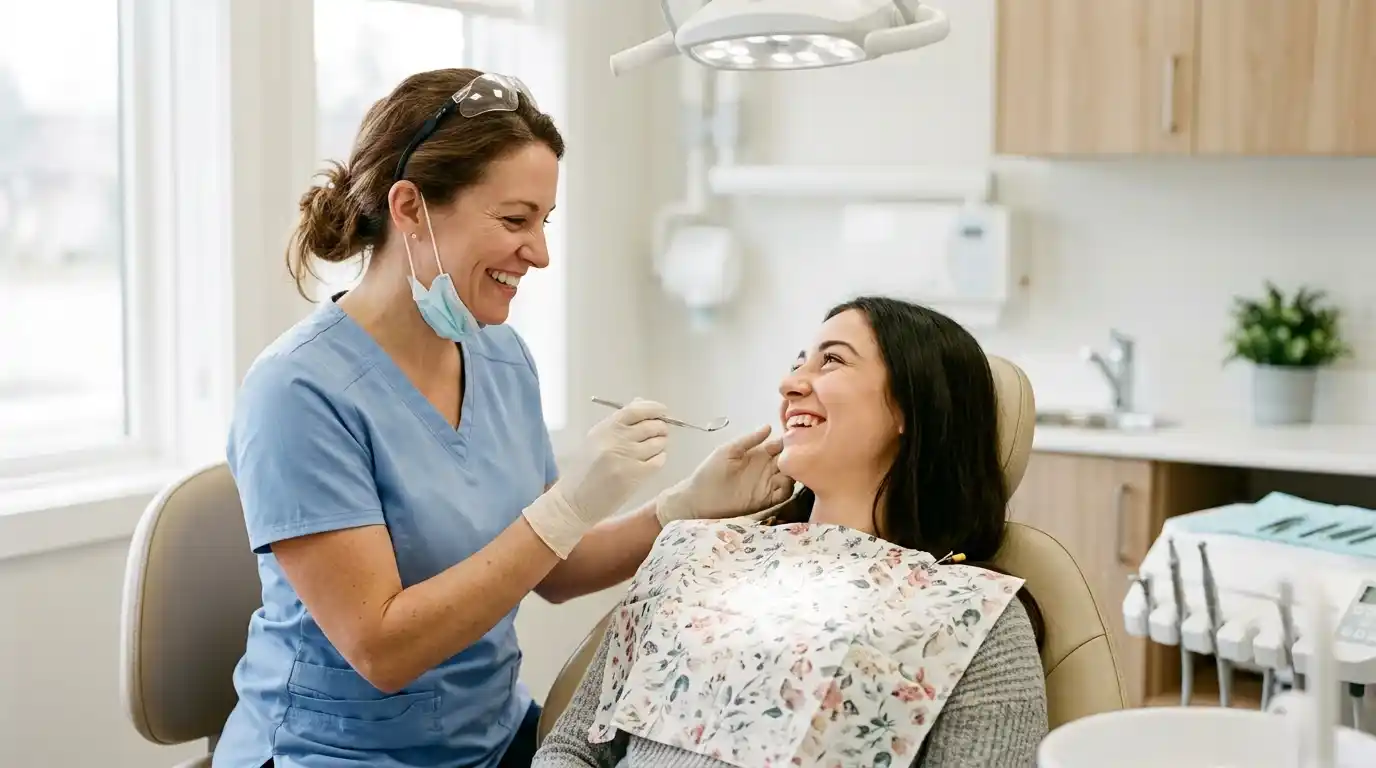
Regular dental checkups prevent serious problems by catching issues cavities, gum disease, oral cancer, and more while they’re still small, painless, and inexpensive to treat, before they progress into conditions that require major treatment or can affect your health beyond your mouth. Most serious dental problems don’t start as emergencies; they start as something small enough that only a trained exam would notice.
Here’s exactly what a checkup catches, and why that matters more than most people realize.
What Actually Happens During a Checkup
A routine checkup isn’t just “look and clean” it’s a systematic screening covering several things at once:
Visual exam. Your dentist checks every tooth surface for early signs of decay, cracks, or wear that aren’t yet causing symptoms.
X-rays. These reveal decay between teeth and below the gumline, bone loss, and issues with tooth roots none of which are visible to the naked eye, and none of which you’d feel until they’re advanced.
Periodontal probing. Measuring the depth around each tooth identifies gum disease at its earliest stage, before it causes visible symptoms like bleeding or recession.
Oral cancer screening. Your dentist checks your tongue, cheeks, throat, and neck for unusual lumps, sores, or discoloration often catching signs years before they’d otherwise be noticed.
Bite and jaw evaluation. Checking for signs of grinding, TMJ strain, or bite misalignment that can cause damage over time if left unaddressed.
Professional cleaning. Removing tartar that’s already hardened onto teeth something no amount of home brushing can do which is often what’s actively driving gum inflammation.
Specific Problems Checkups Catch Before They Become Serious
Cavities, while still small. A cavity caught early needs a simple filling. Left undetected, it grows toward the tooth’s nerve, eventually requiring a root canal or extraction a dramatically bigger, more expensive, more painful procedure for the exact same starting problem.
Gingivitis, before it becomes periodontitis. Gum inflammation is fully reversible at the gingivitis stage with a cleaning and better home care. Left unchecked, it progresses into periodontitis permanent bone and tissue damage that can loosen or cost you teeth.
Cracked teeth, before they fracture further. Small cracks are often painless and invisible without an exam, but they can spread deeper over time, especially under normal biting pressure, until the tooth requires a crown or is lost entirely.
Oral cancer, at its most treatable stage. Oral cancer often has no early symptoms a person would notice themselves. Routine screening is frequently how it’s caught in its most treatable early stage rather than after it’s spread.
Old dental work failing silently. Fillings, crowns, and old root canals can develop small gaps or wear over years without any noticeable symptoms, letting bacteria back in underneath something only visible on an X-ray or during a close exam.
Enamel erosion and early tooth wear. Grinding, acidic diet, or dry mouth can wear down enamel gradually. Catching this early allows for a night guard or minor intervention instead of needing crowns on multiple worn-down teeth later.
Why This Also Protects the Rest of Your Body
This is the part most dental content skips entirely, but it’s significant: oral bacteria and the inflammation from untreated gum disease don’t necessarily stay contained to your mouth. Research has linked poor oral health to several broader health conditions, including cardiovascular disease, where inflammation and infections from oral bacteria may play a role in clogged arteries and stroke risk; pregnancy complications, where periodontitis has been linked to premature birth and low birth weight; and pneumonia, where oral bacteria can be inhaled into the lungs and cause respiratory infection. The connection runs both ways too people with diabetes are at higher risk for more severe gum disease, and research shows that treating gum disease can actually improve blood sugar control.
This is exactly why a routine checkup isn’t just about your teeth untreated oral infection and inflammation is a health issue with reach beyond your mouth, not just a cosmetic or comfort issue.
The Cost of Skipping Checkups (It’s Not Just Money)
Financially: a checkup and cleaning costs far less than the procedures that result from a problem left to progress a small filling versus a root canal and crown, or a simple cleaning versus deep scaling and root planing for advanced gum disease.
In treatment complexity: early problems are almost always simpler to treat. A cavity becomes a root canal. A loose filling becomes a bigger repair. Gingivitis becomes periodontitis. Each stage of delay generally means a longer, more involved fix.
In what’s reversible vs. permanent: this is the biggest one. Gingivitis is fully reversible. Bone loss from periodontitis generally is not. Catching things at the reversible stage is often the entire difference between “fixed” and “managed for life.”
How Often Should You Actually Go?
Most people benefit from a checkup and cleaning every six months, though your dentist may recommend a different schedule based on your specific risk factors more frequently if you have a history of gum disease, are prone to cavities, smoke, or have a condition like diabetes that affects healing; potentially less often if you have excellent oral health and low risk. This is worth discussing directly with your dentist rather than assuming a fixed schedule applies to everyone.
This is part of why catching tartar buildup early matters so much a professional cleaning removes it long before it has the chance to progress into gum disease or contribute to a cavity.
FAQ
Do I need a checkup if nothing hurts?
Yes this is exactly the point. Most serious dental problems, including cavities, gum disease, and oral cancer, don’t cause noticeable symptoms until they’ve already progressed significantly.
How much does skipping checkups actually cost in the long run?
It varies, but the pattern is consistent: early treatment (a filling, a cleaning) is almost always significantly less expensive and less invasive than the treatment required once a problem has progressed (a root canal, a crown, deep gum treatment, or extraction and replacement).
Can a checkup really catch something as serious as cancer?
Yes oral cancer screening is a standard part of a routine dental exam, and catching it early significantly improves treatment outcomes.
Is it too late to start regular checkups if it’s been years?
No starting now, whatever your current oral health looks like, gives your dentist the chance to catch and address anything developing before it becomes a bigger problem.
Does gum disease really affect my overall health, or is that overstated?
It’s a genuine, researched connection oral inflammation and bacteria have been linked to cardiovascular disease, pregnancy complications, respiratory issues, and worse blood sugar control in people with diabetes, among other conditions.
When Was Your Last Checkup?
Catching a problem early is almost always simpler, less expensive, and less invasive than treating it later. Summer Smile Dental in South Gate makes it easy to stay on schedule and catch anything before it becomes a bigger issue. Schedule your checkup today.